

SEO-Friendly URL Structure: Best Practices & Examples
- Kruti Varma /
- 2026-09-03 /
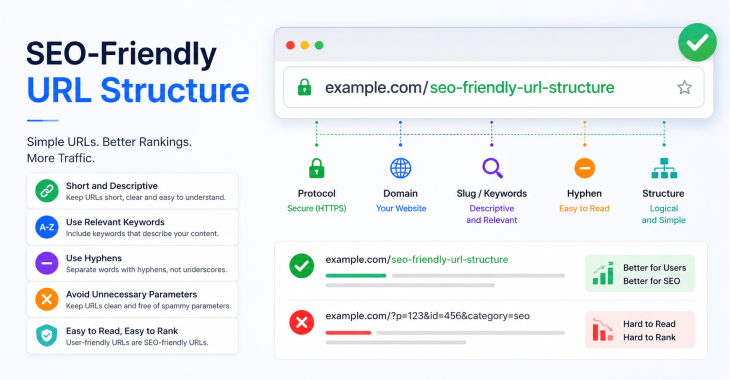
A clean URL structure helps search engines understand page topics quickly and improves user navigation. This article covers practical, implementable strategies for building SEO-Friendly URL Structure that supports both discovery and usability.
A well-crafted URL should be readable, keyword-relevant, and stable over time. It influences click-through rates in search results and reinforces the page’s topic to crawlers. Below are concrete guidelines, examples, and patterns you can apply across your site.
Why URL structure matters for SEO
- Search engines use the URL as a signal of page relevance. Clear keywords in the path help matching intent.
- User experience improves when URLs are concise and descriptive. This reduces bounce risk and aids sharing.
- A logical hierarchy makes it easier to organize content and implement site-wide navigation and breadcrumbs.
Focus on structure, readability, and consistency. The goal is to produce URLs that communicate topic, hierarchy, and intent at a glance.
READ MORE: On-Page SEO Checklist: 25+ Steps to Optimize Your Website
Core principles of SEO-Friendly URL Structure
- Descriptive and keyword-relevant
- Short and readable
- Stackable to reflect site hierarchy
- Stable and deterministic over time
- Use hyphens to separate words
- Lowercase only
- Avoid dynamic parameters when possible
Applying these principles helps both users and search engines.
Descriptive and keyword-relevant
URLs should indicate the page topic. Use a primary keyword while avoiding stuffing. If the primary keyword is SEO-Friendly URL Structure, that phrase should appear naturally in the URL only where it fits your site’s hierarchy.
Short and readable
Aim for 50–60 characters when possible, but prioritize clarity over exact length. If a page’s topic is broader, you may need a longer slug, but keep it as concise as possible.
Stackable and hierarchical
Reflect site taxonomy in the URL. A logical hierarchy helps navigational cues and breadcrumb trails. Example: /blog/seo/optimizing-url-structure.
Stability and determinism
Avoid changing URLs after publication unless necessary. If a URL must change, implement proper 301 redirects from the old slug to the new one to preserve SEO value.
Hyphens, lowercase, no special characters
Hyphens improve readability. Avoid underscores, spaces, and non-ASCII characters unless you have a strong case. Keep the URL strictly lowercase.
Recommended URL patterns
- Category-based: /blog/seo/keyword-research-guidelines
- Topic-first: /seo/seo-friendly-url-structure
- Product-style (if applicable): /products/seo/url-structure-checklist
- Publication date (optional, for news): /news/2024/08/optimizing-url-structure
Choose a consistent pattern across the site. The pattern you select should align with existing content and future content plans.
URL components to optimize
- Path: The main portion after the domain. This is the most visible part of the URL.
- Slug: The specific page segment within the path. It should be concise and descriptive.
- Query parameters: Use sparingly. When used, ensure parameters do not create a messy crawl path.
- Trailing slash: Be consistent in using or omitting.
Avoid including stop words (a, an, the) unless they contribute to clarity.
READ MORE: SEO Audit for Small Business: Complete Step-by-Step Guide
Breadcrumbs and internal linking
- Use URLs that support breadcrumb trails. Pages in the same section should share a common path prefix.
- Internal links should point to semantically related pages with clean slugs. This reinforces topical authority.
Handling categories, tags, and archives
- Prefer category-based structuring for main content over tag-based URLs, as categories reflect topical hierarchy.
- Archive or date-based blocks can be useful for chronological content but should not clutter the main slug. Use a separate index page for dates if needed.
International and language considerations
- Use language prefixes for multilingual sites, e.g., /en/blog/seo-friendly-url-structure.
- Maintain consistent slug conventions across languages to avoid confusion.
Common pitfalls to avoid
- Keyword stuffing in the URL
- Irregular or changing slugs after publication
- Using session IDs or tracking parameters in the path
- Overly long slugs that obscure meaning
- URL duplication due to trailing slashes inconsistencies
READ MORE: SEO Mistakes to Avoid: 15 Common SEO Errors That Hurt Rankings
Practical examples
- Blog post about URL readability: /blog/seo-friendly-url-structure/readability-and-ux
- Guide to canonicalization: /seo/understanding-canonical-urls
- Case study on URL redesign: /case-studies/semantic-url-restructure
These examples illustrate how to encode topic and intent into the URL while keeping it readable.
SEO-Friendly URL Structure for site redesigns
If you’re redesigning an existing site, plan with redirects and inventory. Steps include:
1. Inventory current URLs and map to new slugs.
2. Group pages by topic and assign new slugs that reflect the hierarchy.
3. Implement 301 redirects from old to new slugs.
4. Update internal links and sitemaps to reflect the new structure.
5. Monitor crawl errors and adjust as needed.
A careful approach preserves link equity and avoids broken pages.
How to audit your URLs
- Check for consistency in slug format across the site (lowercase, hyphenated).
- Ensure the URL reflects the page topic without extraneous words.
- Verify that no dynamic parameters are embedded in main paths.
- Review new content creation to maintain pattern adherence.
Regular audits help maintain a clean, scalable URL structure over time.
Implementation tips by platform
- WordPress
- Use a custom permalink structure that mirrors your taxonomy, such as /blog/%category%/%postname%/.
- Keep category slugs short and descriptive.
- Redirect old slugs when changing taxonomy or post slugs.
- Static sites (Jekyll, Hugo)
- Structure folders and slugs to reflect hierarchy, e.g., /blog/seo-friendly-url-structure/index.html.
- Use front matter to drive breadcrumb and taxonomy consistency.
- E-commerce platforms
- Align product and category URLs with a clear hierarchy, e.g., /shop/seo-tools/url-analysis.
- Avoid query strings for product pages unless necessary for variations.
READ MORE: SEO Checklist for New Website: 25+ Steps to Rank on Google
Measuring impact
- Organic traffic: Look for sustained gains after URL restructuring or optimization.
- Click-through rate: Improved title and meta descriptions complement clean URLs.
- Crawl efficiency: Fewer 404s and better coverage after implementing redirects and clean slugs.
- Indexation: Ensure new URLs are indexed promptly without duplication.
Note that changes take time to reflect in search engines. Pair URL improvements with on-page SEO and internal linking to maximize impact.
URL structure patterns to implement today
- Pattern A: Topic-first with category
- /blog/seo-friendly-url-structure/overview
- /blog/seo-friendly-url-structure/advantages
- /blog/seo-friendly-url-structure/best-practices
- Pattern B: Hierarchical taxonomy
- /resources/seo/url-structure-guide
- /resources/seo/url-structure-checklist
- /resources/seo/case-studies/url-restructure
- Pattern C: Product or service focused
- /services/seo/url-structure-optimization
- /services/seo/redirect-strategy
Choose one approach and apply it consistently across new content.
Practical best-practices at a glance
- Use one primary keyword per URL when possible.
- Turn long phrases into readable slugs by removing stop words.
- Maintain stable, descriptive slugs that reflect page content.
- Implement redirects if a slug must change, and update internal links.
- Avoid repeating keywords unnecessarily across multiple slugs on the same site.
Examples of well-structured URLs in action
- SEO-friendly URL structure: /blog/seo-friendly-url-structure/overview
- Readability and user experience: /blog/seo-friendly-url-structure/readability-ux
- Finalizing the approach: /blog/seo-friendly-url-structure/implementation-guide
These examples show how to encode topic, intent, and hierarchy succinctly.
How to handle evergreen content vs. time-sensitive content
- Evergreen content: Use stable URLs that won’t require frequent updates.
- Time-sensitive content: You can include the year or month if it adds clarity, but keep the slug readable and consistent with your overall pattern. For example, /blog/2024/optimizing-url-structure-in-e-commerce.
Balancing stability with relevance is key to maintaining long-term SEO value.
READ MORE: How to Do SEO for a Website: A Step-by-Step Guide
Frequently asked questions
- Should I include keywords in every URL?
- Include keywords where they clearly describe the topic. Don’t force keywords if they hurt readability or introduce redundancy.
- Are dynamic parameters acceptable in URLs?
- Prefer clean, static paths for SEO-friendly URLs. Use parameters only for filtering or session-related tasks when necessary.
- How long should a slug be?
- Aim for concise, descriptive slugs. If needed, extend with clarifying terms, but avoid excessive length.
- Do hyphens or underscores?
- Hyphens are preferred. They improve readability for both users and search engines.
- Should I use trailing slashes?
- Pick a convention and apply it consistently. Most platforms are consistent by default, but ensure redirects align with the chosen rule.
READ MORE: Why Is My Website Not Ranking on Google? 15 Reasons & How to Fix It
Takeaways
- A clean, descriptive URL structure supports SEO and user experience.
- Use a consistent pattern that reflects site hierarchy and content topics.
- Prioritize readability, stability, and lowercase hyphenated slugs.
- Implement redirects carefully when changing slugs, and audit regularly.
Recent Blogs
-
Why Is My Website Page Not Indexed by Google? 12 Reasons & How to Fix It
Posted ::2026-09-24
-
How to Request Indexing of a Website Page on Google?
Posted ::2026-09-19
-
Google Search Console Guide 2026: Complete Beginner’s Guide
Posted ::2026-09-18
-
Keyword Clustering SEO: How to Group Keywords for Better Rankings
Posted ::2026-09-12
-
SEO Audit Checklist: 50+ Steps to Audit Your Website
Posted ::2026-09-11


Our FAQ’s
What is digital marketing?
Digital marketing involves marketing to people using Internet-connected electronic devices, namely computers, smartphones and tablets. Digital marketing focuses on channels such as search engines, social media, email, websites and apps to connect with prospects and customers.
What does a digital marketer do?
Digital marketing has evolved to the point where an immense array of specialists consult with brands to develop effective strategies or implement programs. If you’re new to digital marketing, or lack experience or resources, you should consider engaging an experienced and versatile digital marketing consultant.
Would my business benefit from digital marketing?
Definitely. Though companies in many business categories continue to approach digital marketing with skepticism, avoiding digital marketing denies your business access to the media the majority of consumers turn to first and at all hours of the day.
What’s the biggest mistake digital marketers make?
Blowing their own horn. Yes, of course, the primary goal of marketing is to create leads. However, in the age of digital media a brand-centric, salesy approach deflects interest in your company. Make your marketing customer-centric. Second biggest mistake: Far too often, digital marketers start and stop. You need to contribute a steady flow of content to the channels you use.
How often should I update my website?
Websites that go for long periods with no updates and new content are unlikely to perform well or support any useful digital marketing objectives. Though a static website technically qualifies as a website it’s bound to be more than a digital brochure that produces little or no leads.
What do I need to know about mobile?
Mobile phones are the most used technology in the world. Most of your prospects spend the majority of their media time—and hours—using a smartphone. Mobile marketing focuses on mobile strategies like messaging, mobile applications, and mobile websites. A brand that ignores mobile marketing is doomed.
What is content marketing?
Content marketing is the creation and distribution of educational and/or entertaining information assets for the purpose of generating brand awareness, traffic, leads and sales. Marketing content is generally free and does not explicitly promote your brand as an ad would.
What’s involved in creating a content marketing strategy?
A content marketing strategy is a plan for building an audience. Elements of content marketing strategy include establishing objectives, audience personas, a value proposition, content marketing mission statement, a buyer journey map, and plans for creating, promoting and analyzing how content marketing assets and programs perform.
Do I need a blog?
Email, social media, search and other elements of your digital marketing mix will depend on delivering useful content. Though video outlets, podcasts, and media galleries present other options, a blog is by far the most used tactic for distributing marketing content on a channel over which you have complete control.
What content should we create?
There can be no all-encompassing answer to this question except to say you should create content buyers will find relevant and useful. Leading candidates include blog posts, articles, ebooks, infographics, microsites, videos, courses, case studies, newsletters, visuals and various forms of interactive content.
What is SEO?
Search engine optimization (SEO) is the process of using onsite and offsite tactics to help get content presented by a search engine. Done well, the practice increases the quantity and quality of your traffic.
Why is SEO important?
The majority of web traffic is generated by search and those that come by way of search have a greater degree of commercial intent than most other channels.
What is local SEO?
Local SEO is the process of optimizing your online properties to generate traffic from location-based searches. It helps businesses promote products and services to local customers when they need them.
What are keywords?
Keywords are the words and phrases searchers use—usually with search engines—to find relevant pages, images, videos, or any kind of information when looking for answers, knowledge, products, or services. SEO professionals consider keywords and the topics they suggest when optimizing content for search.
What determines search engine rankings?
This question is the source of endless speculation and debate because search engine companies such as Google will not answer it. Experts generally agree rankings are based on relevance and authority, but the factors that determine them are many—and inconsistent. The best way to achieve a high search engine ranking is to create one of the most thorough web pages possible for a specific keyword or topic.
What is PPC?
PPC stands for pay-per-click. Essentially, it’s a way of buying web traffic. Advertisers pay a fee each time one of their ads is clicked. Search engine advertising is the most popular form of PPC, however numerous channels including Facebook now offer PPC ad models.
Why is social media important?
Chances are your audience is active on one or more of the major social networks where billions of people spend time daily. Brands that understand the power of social media marketing and commit resources to it can boost awareness, drive traffic, interact with customers, drive sales, build loyalty, and win advocates.
What is a lead magnet?
A lead magnet is a free offer you make in exchange for an email address (and possibly additional information). The purpose is to inspire prospects to join your email list by offering something of value. Examples include an ebook, guide, report, assessment, cheat sheet, tool, template, webinar, course, or a coupon.
What is a call to action?
A call to action (CTA) is a prompt that instructs the viewer to take a specific action. A call to action is typically written as a command, such as “Buy Now.” In digital marketing a CTA generally takes the form of a button or link.
How long does it take to see results?
Paid digital marketing programs should create results immediately. On the other hand, programs such as content marketing, email list building, and search engine optimization require persistence and patience. You might see some results in a matter of months; however, it’s likely to be six months to a year before you realize some of your traffic and conversion objectives.